
A Gate 2 offer and the commitment fee
What’s your Gate 2 offer worth with the new commitment fee?
Accept all your MW, cut back, or walk away?
QueueQuant optimises your plan across thousands of possible futures, the bad ones included.
Your site, through our engine. Independent, under NDA.
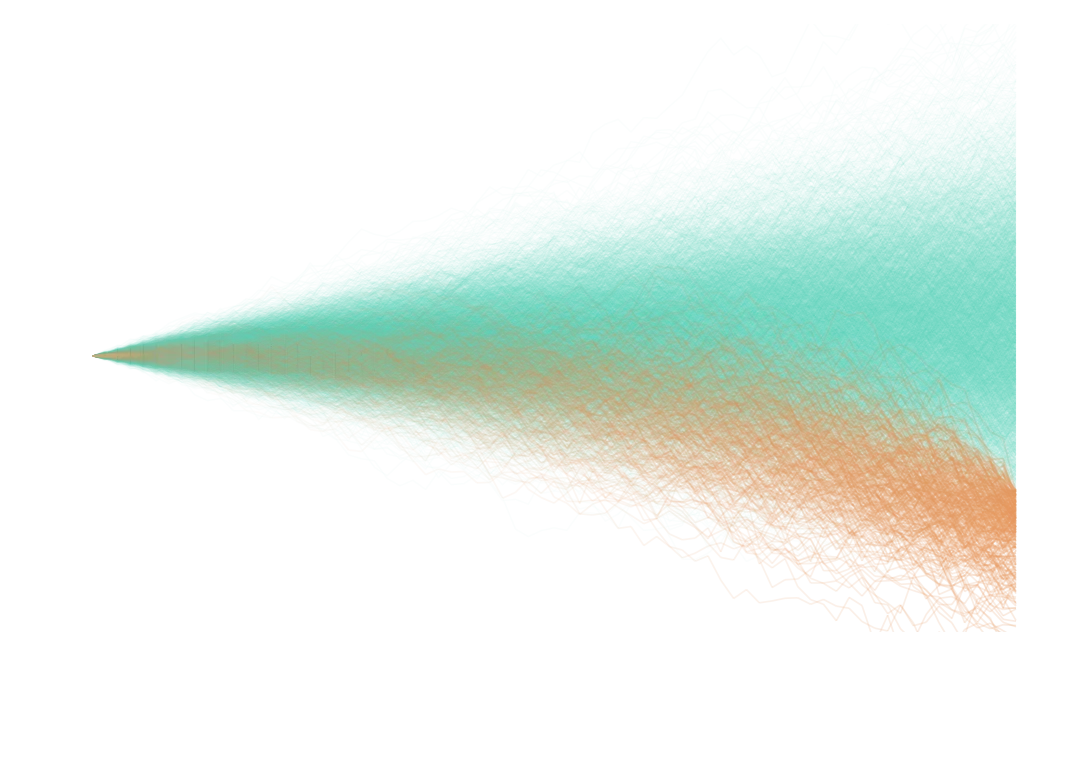
Nobody knows which future you’ll get, so we find the plan that holds up best whichever it is.
594.9 GW and 16.9 GW: NESO TEC register of 16 Nov 2026. 112.4 GW: capacity accepted to connect at sites of 1 MW and over in the six DNOs’ latest Embedded Capacity Registers (August, September, October and November 2026 editions). Supported by National Energy SO Open Data. Supported by Northern Powergrid Open Data.
Mapping tools tell you where the grid is constrained. They can’t tell you what to do about it. Under TMO4+, Gate 2, and monthly reissued assessments, the queue is a moving target, and deterministic studies price a single future that never arrives. Developers sign non-firm connections blind to curtailment, or over-build firm capacity they’ll never use. Either way, capital freezes.
Connection assessments are reissued on a rolling basis. Last month’s optimal decision is this month’s stranded capex.
A fast non-firm connection can be curtailed 2% of the year, or 35%. Unpriced, that gap is the difference between a strong IRR and insolvency.
Self-build HV, private wire, and co-located BESS bypass the queue, but they demand large, hard-to-reverse capital commitments made under deep uncertainty.
QueueQuant integrates machine-learning forecasting across price, curtailment, and queue-timing risks with multi-stage stochastic mixed-integer optimisation under full recourse.
Solves MW capacity, BESS duration, private wire, contestable ICP works, and backup generation together, to structurally minimise stranded capex under queue uncertainty.
Quantifies the 1-in-20 downside, protecting investment committees from catastrophic delays and unpriced curtailment volatility.
Pinpoints the exact inflection points where queue slip or curtailment flips the optimal pathway between Gate 2, non-firm, private wire, and off-grid.
Evaluates counterfactuals and regret surfaces to uncover the hidden option value that deterministic studies overlook.
Multi-dimensional ML forecasting across price, curtailment, and queue-timing risk generates a probability-weighted scenario tree over the full asset horizon.
A multi-stage stochastic MIP solver co-optimises structural decisions today against operational recourse across every scenario: sizing, dispatch, and pathway.
A capex-versus-risk frontier, tail-risk metrics, and a single recommended pathway, recalculated whenever the network registers change.
Your 50 MW battery project holds a grid connection agreement for July 2030. Under the connections reform, your new connection offer (your Gate 2 offer) is due within the year, but nobody knows when it will come or which connection date it will bring. Even after it comes, the date can still slip, and curtailment, connection costs and battery revenues stay uncertain until nearer the build.
Your questionsSee how the engine answers them, step by step, and move the sliders to test your own view.
A hypothetical project. Every bid in this table is calculated by the QueueQuant engine.
A Gate 2 offer and the commitment fee
Accept all your MW, cut back, or walk away?
The commitment fee and the battery queue
Which batteries leave, which sell, and which stay?
Falling revenues and the battery queue
The evidence we sent Ofgem for its CMP470 impact assessment
We’re built for the decision that comes after the search. Once a site is in play, the question stops being “where is there capacity?” and becomes “which pathway, at what risk, sized how?” That question is worth tens of millions more, and it’s the one we’ve automated.
Compress energisation timelines with hybrid private wire, BESS, and flexible grid sizing, and know what each route costs you before you commit the capital.
Co-optimise BESS power and duration, and price the curtailment exposure in a non-firm offer against the wait for Gate 2, in numbers rather than judgement.
Tail-risk (CVaR) underwriting and portfolio valuation your investment committee can interrogate, with every figure traceable to a stated assumption.
years of specialised expertise in stochastic mixed-integer programming, machine-learning forecasting, and energy systems: the foundation QueueQuant is built on. We turn that depth into an enterprise deep-tech SaaS platform: rigorous, repeatable decision-intelligence for the connection queue, delivered as software that re-runs, not a study that ages.
Every developer has one: the offer where signing and walking away both look defensible, and nobody in the room can say which is right. Send us that site and we’ll show you what each pathway is actually worth, independently and under NDA.
Every figure traces to a stated assumption, and we tell you plainly which assumptions would change the answer. It’s built to go in front of an investment committee, not into a drawer.
£7,500 for your first site, invoiced on delivery. If you go on to license the platform, the full amount comes off your first-year fee.
A study of comparable depth from a specialist consultancy is a £30k–£75k engagement running over two to four months. A consultant prices one future, and the registers move underneath it, so the study can be stale before it lands. Our engine re-solves your site across thousands of futures in minutes, which is why analysis at this price can be refreshed when your queue position changes, and run across a portfolio rather than the two or three sites you can currently afford to study properly.
One 45-minute call, your site capacity and capex envelope, and your connection offer if you have one, or the application you’re weighing up if you don’t. Most useful when there’s a decision with a date on it, so tell us the deadline you’re working to.
Invoiced on delivery. Under NDA.
QueueWatch, a free tracker from QueueQuant, shows every change in the GB connection queue. QueueQuant tells you what those changes mean for your project: the plan that holds up best for your site, and where that answer flips.
Open QueueWatch